Affiliate disclosure: This review contains affiliate links. If you buy through one of them, the publisher may earn a commission at no additional cost to you. Commission arrangements do not influence the analysis, cautions, or conclusions below.
Review basis: This article is a research-based revision built on the product's official sales and offer materials as supplied for review, along with the offer data recorded in the original article. Unless explicitly stated otherwise, this review does not claim independent long-term use of the paid product.
Research-Based Software ReviewBookFlipper AI Review 2026: Pricing, OTO Funnel, and Buyer Fit

Quick Verdict
Best fit: Solo publishers and KDP beginners who want one advertised pipeline for research through publishing — and prefer one-time pricing over subscriptions.
Main caution: BookFlipper AI is sold through a ten-upgrade funnel. The article's own "practical stack" math put a working configuration at $161 (front end plus two upgrades); confirm generation limits and inclusions at checkout before budgeting.
Confidence limits: This revision removed the previous version's hands-on testing claims, timing benchmarks, and testimonials — they could not be substantiated. Nothing here verifies speed, quality, or earnings; use the guarantee window to validate the tool yourself.
Quick Overview
| Product | BookFlipper AI |
| Creator | Peter Onwe (as supplied) |
| Front-end price | $17 one-time (early-bird) / $97 regular, as supplied |
| Coupon | FLIP20 — 20% off the front end, as supplied (confirm at checkout) |
| Platform | LaunchPad (JVZoo network), as supplied |
| Niche | Amazon KDP publishing / AI book generation |
| Guarantee | 30-day money-back, as advertised (vendor-controlled) |
| Best suited for | Solo and pen-name publishers, KDP beginners building a portfolio |
| Official link | Check the current BookFlipper AI offer |
Key Takeaways — Read Before You Buy
- Positioning: BookFlipper AI is advertised as a full KDP pipeline — research, gap analysis, manuscripts, covers, formatting, publishing — rather than a plain text generator. Capability claims are described as advertised, not verified.
- Pricing as supplied: Front end $17 early-bird ($97 regular) with coupon FLIP20 listed for 20% off. Ten OTOs run $37–$397; itemized they sum to $1,477, while the original article stated $1,494 — confirm totals at checkout.
- The article's own practical stack: Front end + OTO 1 (Unlimited) + OTO 3 (Cover Suite) = $161 one-time. Treat plan caps and tier inclusions as checkout-confirmation items.
- Evidence boundaries: First-hand test claims and testimonials were removed in this revision. Royalties depend on niche selection, content quality, and KDP compliance — none guaranteed by any tool.
Table of Contents
- What BookFlipper AI Is Advertised to Do
- Who It Fits (and Who Should Skip It)
- The Advertised Workflow in Three Steps
- Advertised Features and Buyer Impact
- What This Review Could Not Verify
- BookFlipper AI Pricing and the Full OTO Funnel
- Upgrade Decision Guide and Total Cost
- Pros and Cons
- Alternatives to Consider
- Buyer Scenarios and Pre-Purchase Checklist
- Frequently Asked Questions
- Final Verdict
- Publisher Bonus Vault
What Is BookFlipper AI Advertised to Do?
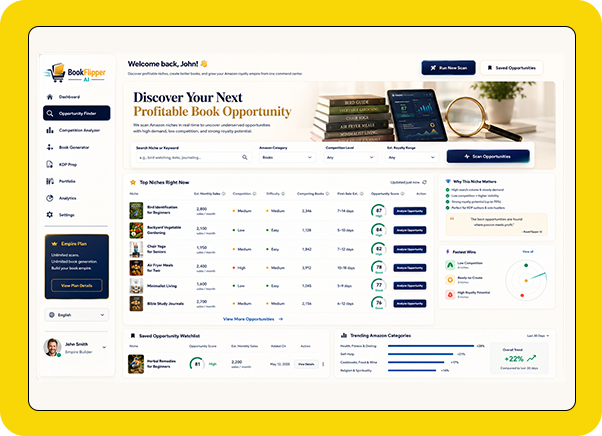
BookFlipper AI is a cloud-based suite marketed as an end-to-end Amazon KDP publishing engine. According to the offer materials supplied for this article, it covers the full production path: niche discovery, gap analysis, manuscript generation, cover design, KDP-ready formatting, and a publishing dashboard. If you have compared every Amazon KDP AI book writer on the market, the distinction being made is scope — most tools stop at text, while this one is built to carry a book from idea to live listing in one workflow.
The offer describes a discovery module that scans Amazon category data for ranked opportunities with demand and competition indicators, plus a gap report meant to shape the manuscript around what readers say is missing. It then generates long-form manuscripts in the 15,000–25,000 word range (as described), matching covers, and listing metadata. Formatting is advertised as automatic, with Kindle and print-ready outputs and a scheduling dashboard.
Platform facts as supplied: BookFlipper AI is sold through the LaunchPad network on JVZoo, uses one-time pricing across the funnel below, and runs in the browser with no desktop install described. The underlying technology — specific AI models, data pipelines, update cadence — is not documented in any materials this review could consult. Treat those marketing descriptions as claims to validate during the guarantee window.
Who BookFlipper AI Fits (and Who Should Skip It)
The manual KDP workflow this product targets is genuinely multi-step: researching demand, checking competition, drafting tens of thousands of words, designing a cover, formatting to Amazon's specifications, and uploading with correct metadata. Formatting and metadata mistakes are commonly the costliest time sinks for new publishers, and coordinating separate tools adds overhead. A consolidated pipeline is a reasonable answer — the open question is execution quality, which this review cannot measure.
One trade-off deserves naming before the fit table. Consolidation reduces control — one system's approach to research, structure, and design instead of specialists per stage. And responsibility does not automate away: Amazon requires publishers to disclose AI-generated content and holds them accountable for quality and rights. Editorial review stays your job.
| Better Fit For | Probably Not For |
|---|---|
| Beginners who want a guided, point-and-click path from research to publishing | Publishing operations needing ISBN management, team roles, and enterprise controls |
| Solo publishers building a catalog of titles rather than betting on one bestseller | Professional authors who need deep control over voice, style, and prose quality |
| Pen-name ("faceless") publishers who want no personal brand, camera, or audience | Anyone unwilling to review, edit, and fact-check AI-drafted manuscripts before upload |
| Side-hustlers batching production into short regular sessions | Buyers expecting guaranteed royalties or a fixed income timeline from any tool |
| Marketers producing lead magnets, low-content books, or bonus assets on schedule | Teams needing multi-user collaboration — no team features appear in the supplied materials |
The Advertised Workflow in Three Steps
Per the offer materials, the workflow runs as follows — advertised behavior, not observed behavior, since no demo was analyzed for this review.
- Niche discovery and gap analysis. Scan Amazon categories inside the dashboard; the system is described as returning a ranked shortlist with demand estimates, competition density, and a gap report summarizing what readers say is missing. How current that data is — and how often it refreshes — is the first thing to verify, because stale data would undermine every downstream decision.
- Manuscript, cover, and metadata generation. The suite is described as producing a long-form manuscript structured around the identified gap, plus a genre-matched cover, listing description, and keyword suggestions. Plan limits matter: the supplied offer information describes a monthly generation cap on the front end, with an "Unlimited Books" upgrade at OTO 1 — treat exact caps and fair-use terms as checkout-confirmation details.
- Formatting, publishing, and tracking. A KDP formatting engine is described as handling trim size, margins, table of contents, and front matter, outputting Kindle and print-ready files, with a release scheduler and catalog dashboard. Automated formatting reduces busywork, but still preview every file in KDP's own previewer before publishing.
Advertised Features and What They Mean for Buyers
Feature 1: Niche Discovery Engine (as advertised)
The discovery module is the suite's differentiator in the sales copy: instead of guessing what to write, you see ranked opportunities with demand and competition indicators before committing to a manuscript. Niche selection is widely considered the biggest variable in KDP outcomes, so the leverage is real. Verify that demand figures refresh, spot-check categories against Amazon itself, and judge whether "gap" reports match real reader reviews before trusting them at scale.
Feature 2: Manuscript Generator with Gap Targeting (as advertised)
Rather than prompting a general chatbot and assembling chapters yourself, the generator is described as structuring full manuscripts around the research findings. The implication is production speed — more finished drafts means more chances to learn what sells. The dependency is quality control: AI-drafted nonfiction needs human editing, and Amazon's policies require AI-content disclosure and prohibit low-quality duplicates. Budget editing time per title.

Feature 3: KDP Formatting Engine and Multi-Format Output (as advertised)
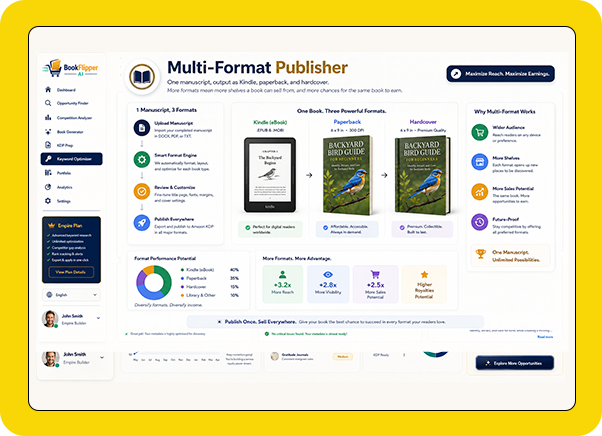
Formatting is advertised as automatic — trim size, margins, table of contents, and required front matter handled for you, with Kindle and print-ready files from the same manuscript. For beginners, this addresses a common sticking point in self-publishing. Verify the output in KDP's previewer anyway, and note the supplied offer information ties hardcover, audiobook, and expanded formats to OTO 5 — confirm which file types your tier includes.
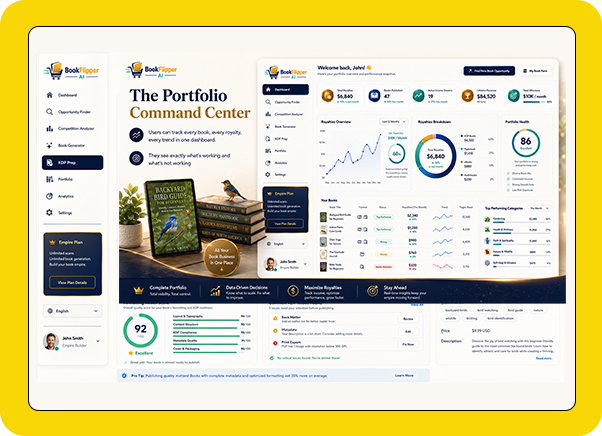
Feature 4: Auto-Publish Scheduler and Portfolio Dashboard (as advertised)
The scheduler is described as releasing books to KDP on a calendar you set, while the dashboard tracks your catalog. Two cautions come with any auto-publishing promise. First, confirm how the automation interacts with your KDP account and what happens if Amazon changes its upload interface — ask support before buying. Second, Amazon's royalty reporting updates on a delay, so dashboard numbers will lag real sales; no tool changes that.

Integration and Technical Boundaries (unverified)
The supplied materials do not document a public API, Zapier or Make connectors, webhooks, or a WordPress plugin, and this review could not verify whether any exist. If your operation depends on piping publishing data into other tools, treat integration support as a pre-purchase question for the vendor. Browser-based operation also means you depend on the vendor's hosting.
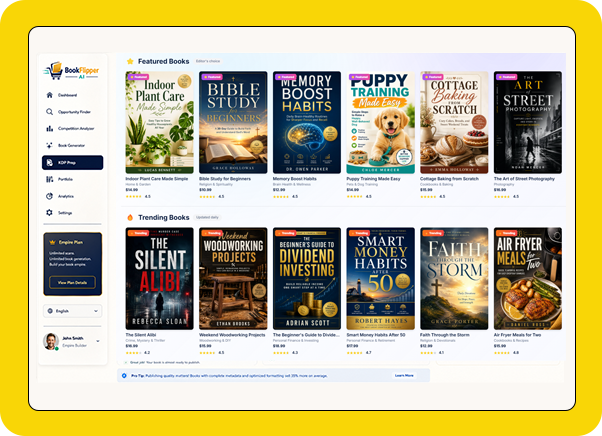
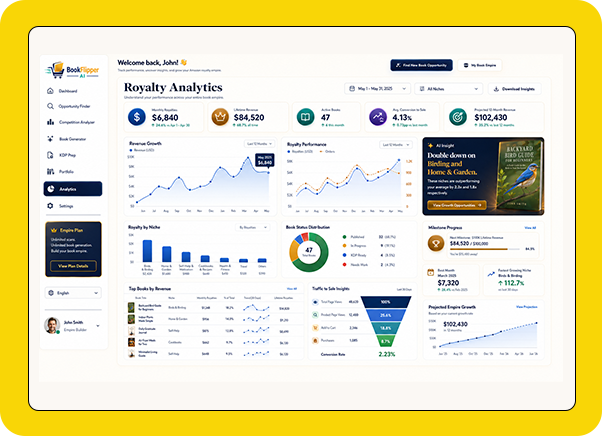
Advertised Interface Gallery
The images below were supplied with the original review materials and are not independently verified as current captures.




What This Review Could Not Verify
Evidence Boundaries — Read This Before the Pricing
This revision is a research-based rewrite, not a hands-on audit. The following could not be verified: current checkout prices and coupon availability; the monthly generation cap and per-tier inclusions; generation speed and output quality; the accuracy of advertised market data; integration and API capabilities; and the vendor's track record beyond the launch platform named in the offer.
The previous version contained first-person dashboard tests, timing benchmarks, niche revenue figures, formatting trials, and named customer testimonials — removed because they could not be substantiated, not because they were proven false. Product images are the originals supplied with the review materials, not independently verified captures.
What this article can stand behind: the funnel structure and prices as supplied, the offer's stated terms, and documented facts about KDP publishing linked in the sources.
BookFlipper AI Pricing and the Full OTO Funnel
Every BookFlipper AI OTO below is reproduced from the offer information supplied for this article, including both downsells. The descriptions summarize what each tier is advertised to add — preserved as stated, not independently confirmed — so treat inclusions and limits as items to verify on the order page.
| Offer | Price (as supplied) | Described to Add |
|---|---|---|
| Front End — BookFlipper AI Starter | $17 one-time (early-bird) / $97 regular | Core suite: niche discovery, gap analysis, manuscript generation, basic covers, KDP formatting, dashboard. Coupon FLIP20 (20% off) listed for the front end. |
| OTO 1 — Unlimited Books | $97 | Described as removing the front-end generation cap, with unlimited searches and a priority queue. |
| OTO 2 — Niche Vault Pro | $67 | Described as 100+ pre-researched niches mapped to seasonal demand, refreshed monthly. |
| OTO 3 — Cover Design Suite | $47 | Described as the full genre-matched cover generator with typography optimization. |
| OTO 4 — Amazon Domination Pack | $97 | Described as keyword and category strategy, launch sequences, and Amazon Ads playbooks. |
| OTO 5 — Multi-Format Publisher | $97 | Described as hardcover, audiobook, and Apple Books outputs alongside Kindle and paperback. |
| OTO 6 — Auto-Pilot Publishing | $67 (downsell: Auto-Pilot Lite $37) | Described as scheduled releases, auto-publishing, a monthly calendar, and series management. |
| OTO 7 — Agency License | $197 | Described as client publishing rights and a client-acquisition blueprint. |
| OTO 8 — DFY Book Vault | $97 | Described as 100 ready-to-publish books with covers and full rights included. |
| OTO 9 — Reseller Account | $297 | Described as reselling BookFlipper AI itself with 100% commission and vendor-hosted delivery. |
| OTO 10 — Whitelabel License | $397 (downsell: Whitelabel Lite $197) | Described as full rebrand rights to sell the tool as your own SaaS under your domain. |
Offer note: Prices and offer terms reflect the information supplied for this review; confirm the final amount at checkout. Tier inclusions and plan limits are summarized from the supplied offer materials, not independently verified. The advertised 30-day money-back guarantee is controlled by the vendor and the sales platform, so read its current conditions on the order page before purchasing.
Arithmetic note: the itemized prices above sum to $1,477, while the original article stated $1,494 — a $17 difference that appears to be a counting slip in the source material. Both figures are legacy data; the checkout screen is the number that matters.
Upgrade Decision Guide and Total Cost
The funnel is straightforward once you separate workflow needs from business models. Volume publishers hit the front-end generation ceiling described in the offer, which is why the original article treated OTO 1 as the first practical add-on. Cover presentation is the other commonly cited gap, where OTO 3 enters. Everything else is optional by use case: OTO 2 for done-for-you research, OTO 4 for marketing depth, OTO 5 for formats, OTO 6 for hands-off scheduling, and OTO 7 through 10 only if you are building a service, reseller, or whitelabel business.
The practical stack, using supplied prices: Front End $17 + OTO 1 $97 + OTO 3 $47 = $161 one-time. That was the original article's recommended configuration, and the arithmetic checks out; what remains unverified is whether each tier includes exactly what the offer says. The front end alone is the cheapest way to learn the workflow, but the described cap may limit production.
Illustrative break-even: if a finished book earned $100 per month in royalties — an assumption for arithmetic, not a claim about typical results — the $161 stack would be recovered once two such books were live and earning. Real KDP outcomes vary enormously; many titles earn little, and Amazon does not guarantee sales. The more defensible advantage is cost shape: advertised one-time pricing avoids the recurring subscriptions and per-book freelancer fees a manual stack of research, writing, design, and editing tools accumulates. Current alternative prices were not re-verified, so they are not quoted here.
Pros and Cons
Pros
- Consolidated pipeline: research, manuscripts, covers, formatting, and publishing are advertised as one connected workflow instead of five separate tools.
- One-time pricing as supplied: the entire funnel is described as one-time payments, with no subscription attached to any tier.
- Low entry point: a $17 front end (as supplied) is a small experiment budget relative to most publishing stacks.
- Advertised guarantee: a 30-day money-back window gives you a defined period to validate the tool on your own account.
- Transparent funnel: all ten OTO prices are itemized above, so the upsell path holds no surprises.
- Faceless model: the pen-name approach fits publishers who want no personal brand or audience building.
Cons
- Ten-upgrade funnel: the front end is an entry point, and the practical configuration described in the source article requires two paid upgrades ($161 total).
- Unverified performance: no independent testing backs the speed, quality, or data-accuracy claims in this revision.
- Plan limits need confirmation: generation caps, format availability, and fair-use terms are exactly the details that change between launches.
- No documented integrations: no API, Zapier, or team features appear in the supplied materials, which constrains scaling operations.
- Compliance is your job: KDP requires AI-content disclosure and holds publishers responsible for quality, originality, and rights.
- DFY duplication risk: if OTO 8 sells the same 100 books to many buyers, differentiation depends on what you change before publishing.
Alternatives to Consider
Three alternatives cover the same job. The generalist route pairs an AI writing subscription with a separate research tool, handling formatting and covers yourself — maximum control, plus recurring monthly fees. The freelance route hires a ghostwriter and designer per title — highest hands-on quality control, highest per-book cost. The manual route uses KDP's own free documentation and templates — cheapest in cash, most expensive in time.
Which path fits depends on what you value: this suite's pitch is speed and consolidation under one-time pricing; the alternatives trade money for control. This revision does not quote competitor prices or benchmarks, because current verified data was not available — the original article's comparison table was removed for that reason. If you are mapping the wider AI content-tool landscape, our ContentClaw review covers a different angle on AI-assisted content production.
Buyer Scenarios and Pre-Purchase Checklist
Scenario 1: The KDP beginner testing the waters
Start with the front end only, or plus OTO 1 if you already want volume. Make the first month a controlled experiment: pick one niche the research module surfaces, cross-check it manually on Amazon, generate one book, edit it properly, and take it through upload yourself. That single cycle tells you more about data and output quality than any review can, and it fits inside the guarantee window.
Scenario 2: The existing KDP publisher scaling output
You already know KDP; you are buying time. The unlimited tier and cover suite are the likely buys, OTO 6 only if scheduled releases match your rhythm. Audit generated manuscripts against your editorial standard before committing to a batch, and evaluate the DFY vault critically — the same pre-made titles may be sold to other buyers, so value depends on how much you rework and differentiate them.
Scenario 3: The agency or reseller
OTO 7, 9, and 10 are business-model purchases, not software upgrades — they only make sense with clients or distribution in hand, and you inherit support obligations for anything you resell. Get license terms, account structures, and update commitments in writing before buying this deep.
Pre-purchase checklist
- Confirm the live front-end price and whether FLIP20 still applies on the checkout page itself.
- Confirm the monthly generation cap on your purchase level and what "unlimited" actually includes.
- Read the 30-day guarantee's current conditions on the order page, including refund-eligible cases.
- Ask how auto-publishing interacts with your KDP account if Amazon changes its upload flow.
- Confirm which output formats (Kindle, paperback, hardcover, audiobook) your tier includes.
- If integrations matter, get written confirmation of API or automation support first.
- Budget editing time per title — production speed does not remove your responsibility for accuracy and quality.
- Review Amazon KDP's AI-content disclosure requirements so your uploads stay compliant from book one.
Frequently Asked Questions
Is BookFlipper AI legit or a scam?
Based on the materials available for this review, BookFlipper AI is a real software offer sold through the LaunchPad network on JVZoo with an advertised 30-day money-back guarantee. That addresses purchase protection, not performance — this revision cannot verify the marketing claims, which is why the previous version's test-based language was removed. The practical risk is not fraud but over-buying: the front end is inexpensive while the ten-upgrade funnel is where budget decisions compound. Set your limit before checkout, confirm the guarantee terms on the order page, and judge the tool inside the refund window.
How much does the full BookFlipper AI funnel cost?
Using the prices supplied for this article: $17 early-bird front end ($97 regular), OTOs 1–10 priced $97, $67, $47, $97, $97, $67, $197, $97, $297, and $397, plus two downsells at $37 and $197. The itemized total is $1,477, though the original article stated $1,494 — a $17 discrepancy noted above. The article's practical configuration was $161 (front end + OTO 1 + OTO 3). Funnels change between promotions, so treat checkout as the source of truth.
Is there a BookFlipper AI coupon code?
The offer information supplied for this review lists FLIP20 for 20% off the front end. Whether the code is live today was not verified, and coupon terms can exclude certain upgrades or expire with the launch window. Apply it on the order page and check the final price before paying. If the discount does not apply, that is a question for vendor support.
Is there a monthly fee?
The supplied offer information describes one-time pricing across the entire funnel — the main structural difference versus subscription tools. Confirm at checkout anyway: launch structures sometimes add recurring elements, and an upsell could carry its own terms. Nothing available to this review documents a required subscription for the tiers above.
Can an Amazon KDP AI book writer actually produce income?
KDP itself is a legitimate, large marketplace — Amazon's KDP documentation, linked in the sources below, is the authoritative reference. What no tool can promise is demand: royalties come from readers, and results vary widely by niche, quality, and timing. Amazon also requires AI-content disclosure and holds publishers responsible for what they upload. Treat production speed as a time saving, not an income guarantee, and validate demand with small, low-cost tests before scaling.
Final Verdict: Is BookFlipper AI Worth It?
This BookFlipper AI review ends where the evidence ends. On paper, the value proposition is coherent: one advertised pipeline covering the entire KDP production path, one-time pricing across the funnel as supplied, a low-cost front end, and a defined guarantee window. For a solo publisher or beginner testing AI-assisted publishing without a subscription, that is a reasonable, budget-limited experiment.
The cautions are just as concrete: a ten-upgrade funnel where the working configuration costs $161 by the source article's own math; tier inclusions needing checkout confirmation; performance claims unverified because the original testing claims could not be substantiated; undocumented integrations; and full buyer responsibility for editing, AI-content disclosure, and KDP compliance on every title.
The fit decision, then, is less about the tool and more about how you buy. If you will validate inside the guarantee window — one niche, one book, honest editing, KDP's own previewer — the downside is capped and the information you gain is real. If you need verified performance data before spending, team features, deep editorial control, or any income guarantee, this offer does not meet that bar on the evidence available.
No numerical rating is given in this revision — a score would imply a level of measured comparison the evidence basis here cannot support. The rating from the previous version was removed for exactly that reason.
Publisher Bonus Vault: Bonuses With This Review
The following bonuses are offered by this site's publisher to readers who purchase BookFlipper AI through the links on this page. They are separate from the vendor's product and its 30-day guarantee, and stated values are the publisher's own list values for the bonus materials, not market prices.
Bonus #1: Custom 10-Niche Starter Pack (stated value $47) — a shortlist of ten niches compiled for this promotion as a starting point for your own research. Use it to skip the blank-page stage of niche selection, then validate each idea against live Amazon data before committing; it is a research shortcut, not a guaranteed-profit list.
Bonus #2: KDP Upload Checklist & Rejection-Proof Guide (stated value $37) — a 22-point PDF checklist covering KDP upload fields, common rejection triggers, and metadata optimization, so your first uploads do not stumble over avoidable formatting and metadata mistakes.
Bonus #3: 90-Day Publishing Calendar Template (stated value $27) — a Notion and Google Sheets template for scheduling your first 90 days of production and releases, helping you pace the portfolio instead of publishing in unstructured bursts.
How to Claim the Bonuses
- Purchase BookFlipper AI through the official offer link on this page: check the current offer.
- Keep your receipt or order confirmation.
- Complete the purchase verification step described on your post-purchase thank-you page.
- Bonuses are delivered by email within 24–48 hours after your qualifying purchase is verified.
Check the Current BookFlipper AI Offer
If the advertised pipeline and the supplied pricing fit your publishing plans, the next step is the order page itself — verify the live price, the FLIP20 coupon, and the current guarantee terms, then test the workflow inside the guarantee window.
Check BookFlipper AI at the Official Offer PageSources and Methodology
General background references (independent of the vendor):
- Amazon Kindle Direct Publishing — Wikipedia (platform background)
- Amazon KDP Official Documentation (formatting specifications, upload requirements, content and AI-disclosure guidelines)
- JVZoo Marketplace (the sales platform named in the offer materials)
Methodology. This article is a revision of a previously published review on this site. The revision inventoried the original article's claims, removed unsupported first-hand testing claims, timing benchmarks, niche revenue figures, third-party comparisons, and reader testimonials, and preserved the offer pricing as supplied. No live checkout, vendor sales page, demo video, or product account was inspected for this revision, and no external product evidence was supplied. Where the original article stated figures that conflicted with its own itemized data — the full-funnel total — both are reported. Affiliate links in this article point to the offer destination contained in the original materials; the publisher may earn a commission on qualifying purchases.
About the Reviewer
Aakif Kausar examines official product materials, vendor demonstrations, funnel pricing, licensing information, documented limitations, and buyer fit to help readers make clearer purchasing decisions. Unless explicitly stated otherwise, this review does not claim independent long-term use of the paid product.
This article was originally published on this site in July 2026 and revised in its present form by Aakif Kausar, who is responsible for the analysis above. The revision removed unsubstantiated testing claims and ratings and clarified the review's evidence basis and methodology.
Editorial correction: This review was revised to remove unsupported first-hand testing claims and clarify the sources and limitations of the analysis. Ratings and reader testimonials from the previous version were removed because they could not be substantiated.


Pingback: CopyCat AI Review: Is This AI Campaign Cloning Tool Worth It?
Pingback: KDPilot Review 2026: 7 Brutal Truths About This AI Publisher